Wednesday, March 19, 2014

LED Lighting Product Quality

What's should we be looking at LED lighting product for quality?

* Color Temperature and Color Rendering Index (Quality of light)
    Like CFL/Fluorescent light, LED light is not a full spectrum light (vs incandescent light). Early LED light products usually look bluish at around 6500K, for its high lumen efficacy number. Recent years there are more day light white (5500K) and warm white (below 3000K) products which are more suitable to human visible range.
    Color Rendering Index (CRI) is the number in percentage to measure how good the ability of light to bring out true color of objects, Incandescent light bulb is highest as 100. Usually you want the number to be greater than 70 for most applications, professional who works with color would require 90 or higher CRI.
* Heat Handling (Quality for product life time)
   Almost all electronic parts emits some heat, that is especially true for LED products. Lighting grade LED converts about less than 33% of energy into light; the rest would become heat. Driver does better that has only less than 20% of energy become heat. The number is better than traditional light source such as incandescent, fluorescent or HID. However, traditional light sources work at much higher temperature above 400F(200C) or higher; on this end, electronic parts usually won't be able to sustain more than 250F(120C). That's why LED lighting is more sensitive to heat. Heat can damage LED, shorten their life span, decrease light output and ruin their CRI.  Similar effect applies to driver, too.
    Thermo design is big topic in LED lighting since beginning. It's complicated and no fixed rule for user to exam products. One general rule is metal conduct heat better than most of other materials; the other rule is size counts. lots of heat trap in a small space isn't a good thing.
* Energy efficiency
    There are some room of difference in energy conversion rate among various LED products. Since lumen is measured as energy, blue light has higher lumen number than other light. LED working temperature also plays a role, too. Cooler LED does better work to convert electricity into light. Of course, circuit efficiency made few difference, too.

    All these variance doesn't compare to difference made by basic lamp design. LED by nature is directional light source, while all other light source is omnidirectional. Use LED to make a omnidirectional lamp requires mounting LED at different directions.  On the other hand, use other light sources to make a directional lamp, such as ceiling light/Wall light/ shop light, usually include reflective panel to reflect light to desired direction. But no matter how it does, there is no match to directional lamp that uses LED. in some cases, directional LED lamps use only half of energy as fluorescent ones.


Easy LED Lighting quality

Our LED module uses aluminum plate as mounting bracket, which also makes direct contact with the belly of all LEDs.  The aluminum takes heat away from LED and allow them to work at much cooler temperature.
Our LED kit or lamp uses external driver that has much durable design. It's water and dust proof and doesn't have to be crumble together LED heat source.

Monday, March 17, 2014

LED tube demystify


LED tube is a newly emerging product from China. They typically have aluminum back half tube, diffuser from tube cover, LED PCB and driver circuit. The whole thing is packed inside a narrow long tube that has less than an inch in diameter, compatible size as fluorescent tube in order to retrofit. LED tube usually use many small low power LED, typical hundreds of them. Because the distance between LED and diffuser is less than half inch, to make the light output look uniform, the distance between LEDs should be less than that too.  Depends on the design, a typical 4 foot long T8 LED tube uses 18W ~ 22 Watt of power, is less than average 32 Watt used by fluorescent tube to achieve same brightness..


Although the goal was to retrofit into existing fluorescent light fixture, there is a ballast between household AC and fluorescent tube connectors to reduce current in  fluorescent system. Install LED tubes into fluorescent fixture need to bypass this ballast, and there are two kinds of LED tube standards that's not compatible with each other. Mix use these two may cause catastrophic damage and dangerous. Therefore remove or bypass the fluorescent ballast is considered invalidation UL warranty.   

Put that aside, diver used in LED tube has to be crumple inside a tiny space that's less than half of tube. So their design is usually delicate. Since both of LED board and driver generate great deal of heat in such a close proximity, they affect each other in many aspects. There are reports about poor lifetime of driver and color degeneration of LED at near the driver.   

On the contrary, Easy LED kit or lamp use external driver with good safety and quality, and our module handles heat excellently, we believe is a much better choice than LED tubes. Easy LED kits and Lamps can be get at easyledlighting.com

Friday, March 14, 2014

Is it easy to install Easy LED kit?


My kitchen, about the size of 14x10',  has build-in ceiling light that was using fluorescent tubes. There were 4 four feet long T5 tubes that were installed inside the 11" ceiling space and were using totally 120 Watt of power when turn on.
Fluorescent tubes has a shorter life span and it was really a hassle to replace a 4 feet long glass tube. As I started this LED business, my first order was to replace this ceiling light.

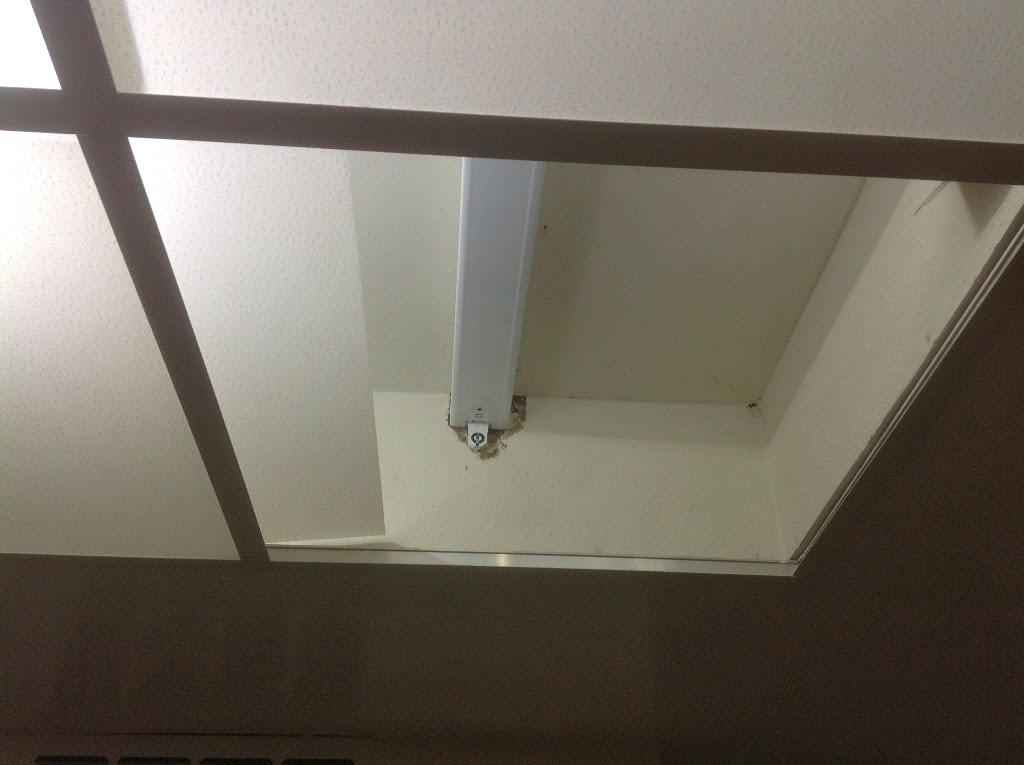
This ceiling light is actually very simple with 2x2' diffuser panels. The diffuser panel can be easily push up and move to the side to reveal access space for works like replace fluorescent tubes.

To install Easy LED kit,  The first step is to remove all fluorescent tubes and find the power feed. I did not remove the old fluorescent lamp base; I just leave them in there to reduce the junk I had to remove for this project. But it's a good idea to disconnect the old ballast from power feed as the ballast would still consume a little bit of power despite tube is removed.

The second step is to install LED modules at proper locations. Our standard modules are pre-bent to 90 degrees and pre-wired. So the location of the modules are determined by wire connectivity. Handle module via its metal bracket; DO NOT touch the LED balls. Remember the LED driver need to be placed near the power feed, and the rest of modules should just follow the wires to deploy. Modules are installed flat side against ceiling so the LED are facing downward.

To install them to a clean and flat surface, we can just use its back double sided type to stick to surface, remember to push it really hard (pressure) against the surface and allow dwell time (1 hour) to let the adhesion to set before turn on the light.

On a not so clean surface such as old dry wall surface, use included screws to enhance fastening. When I install them on dry wall, I don't even need to pre-drill hole, just push it into the dry wall. And I only use one screw per module.  

Once those modules are set and wires are arranged. the next step is to connect the wiring, just follow this link to connect them.

The whole installation was very easy and didn't take much time. At end, just make sure the lights are working before we close the diffuser panels. Once that was done, just enjoy the very bright and energy efficient LED light.

I used 4 modules that consumes 60 Watt of power, which is only half as before. But then my kitchen is already the brightest room in my house.

4 modules Easy LED kit is on sale at easyledlighting.comfor less than $70


Wednesday, March 12, 2014

LED grow light project

There has been interests about using LED light to grow plants indoor. There are also question about whether our light spectrum is suitable to grow plant. To put these arguments to stop, I have conduct a test to find out all the answers. I put two strawberry plants inside a closure space of Old TV cabinet. When door closed, there is absolutely no other light can get into this cabinet, the only light source is one of our Easy LED module running at 15 Watt.

 I have a timer set to light up this cabinet 12 hours a day to simulate real sunlight also.

I did some reading about general grow light, there are article saying the light need to be above certain strength to enable plant for photosynthesis instead of respiration. Our LED module emits a lot of light for illumination, for people to see things. But there is no comparison to strength of sunlight, which some time can burn your skin, and we generally don't want that kind of light strength in our house either.

But the purpose here is to grow plant, we we can shorten the length between light source and plants. I initially set the LED module fixed at top of cabinet, which is 25" away from the plants. I use a Lux meter and got 800 lux reading. Then I use two thin strings to lower the module to 16" above the leaves, my Lux meter read 2500 lux.  Since our module is so light weight, about 2 oz, it can be easily hang at desired height.

A TV studio only need requires 1000 lux of light intensity.  2500 lux is compare-able to sunlight of a overcast day.

At shorter distance, the light is much intense, too bright for viewing with general indoor ambient light; but it's perfect for growing plant.


The project is still on going, those two strawberry have been inside the closed cabinet for over 10 days by now. By compare photos from beginning and now, I sense that both strawberry have been grow bigger, healthier, with just LED light.

10 days after project started
10 days after project started.

19 days after project started

Above photos shows 10 days/18 days after project started, the two strawberry looks bigger/taller and healthy; if the light doesn't work, these plant should be withered already.


You can order Easy LED kit at easyledlighting.com and specify LED modules to be unbent.


Wednesday, February 26, 2014

Color temperature of lighting and living


Do you know lighting can affect your mood? That's very true. From long ago our ancestor live on this planet; not around the clock but around day light. They went to sleep when it's dark and woke up to work or hunt when sun came up. And you probably already noticed, sky or sunlight has different color temperature around the day. When dawn or dusk, the sky is more close to orange/yellowish; but it turns into more bluish white when went into day.

According the light spectrum of natural light, lighting manufacture developed different lighting products with different color temperature. Daylight white products are more suitable for work, and warm white products are more relaxing and good for resting.

Take myself for example, I equipped all bedroom/bathroom in my house with warm white light; and I changed rest of house into daylight white LED. That has a very dramatic effect for me and my family. For example, my daughter always had problem to wake up in time to finish breakfast before school. Ever since I changed family room with daylight white LED light, I just have to carry her to family room and she would become fully awake very soon.

Another example is lighting at my work place. I work at a large office building which has all integrated lighting, therefore I can't change the lighting setup myself. Under this soothing and relax lighting, I always felt tired and need to fight drowsiness while doing boring daily business work. But ever since I put a 15Watt Easy LED module on top of my office cabinets, I feel much alive and awake everyday at work. That 15Watt of LED light isn't much, but by blending in just a little bit of daylight white light together with original warm white light, it has great impact on me and improved my performance at work.


On the contrary, I wouldn't use any bluish or daylight white light in my bedroom. I usually sleep light and there are certain point at night, once pass that point, it would be hard for me to fall into a good sleep, sometime even for hours. There are reports say,  even watching iPad before sleep may spoil  precious sleepiness for some, let along lighting...

<PS> Daylight white LED products can be found at easyledlighting.com

Saturday, February 22, 2014

World Lamp safety

How safe is World Lamp? When you put together the lamp shell, have you ever wonder this question? It's obvious that this lamp shell is not water tight, what if the fire alarm sounds and fire sprinkler starts? To see this video for yourself. Although this video may look funny, but make sure you don't do that at home. And this lamp is not designed for weather, so don't use it at outdoor.
As far as fire safety, all our lamps are running cool, much better than other brand of LED lamps, I can even touch it after it is turn on for a long time. Human skin can withstand about 60C or  140F. The fact I can hold my finger on the metal bracket says it's temperature is still below that.


Thursday, February 20, 2014

Will LED bulb pay for itself?


When we talk about something saves, a common phrase we would often use is: "It will pay for itself.", Can we use the same phrase on LED bulbs? Let's start with the math.


 A 60 watt equivalent LED bulb right now retails for $12.75 and uses about 10W of power.
A common competitor 60 watt equivalent CFL bulb cost much than that (often less than $1 when with rebate) and use about 14W of power.
If we run one light bulb 6 hours a day, for 8 years it would have run for 17520 hours.
 
10 Watt LED bulb would consume totally 175.2 kw-hrs, which cost $29.78
14 watt CFL bulb would consume totally 245.28 kw-hrs, which cost $41.7
            (based on 17 cents per kw-hrs PG&E average residential rate)


The $12 difference in electricity cost would just pay for the LED bulb; but it took 8 years.
Of course, if that light bulb is light up 24/7, it would be faster, but still needs 2 years,

The real energy saving of using LED light is from its directionallight source characteristic when with right application ... 

Eg.  Our world Lamp 30 Watt LED shoplight (uses 32watt power) has light intensity compare to traditional shoplight with two 4' T8 tubes, that's roughly 64 Watt power usage.   Click here to see our shoplight compare to LED bulbs.

For the same case of 8 years.
Traditional shoplight would use 1121.3 kw-hr, that's $190.6 electricity bill
World Lamp LED shoplight would use 560.6 kw-hr, that's $95.3 in electricity bill, 
The cost saving is more than two World Lamps ....